One of my all time favourite charms uses the phrase ‘Lord, set it right again, right’, and although unrelated to the topic at hand, it in some ways defines the practice we will be talking about today – Saining. The infamous term that goes round social media every 6 weeks with people using lavender, rose petals, and other non-Saining crap to ‘cleanse’ their homes.
Although we don’t have an exact date for the practice beginning, we have accounts of it from the 1500s (although more commonly the 1800s) to the present day (Carmina Gadelica, The Sun Dances, Gaelic Incantations as a few sources to look at). Saining is a practice found mostly in Scotland, however we can also find it in Iceland at New Year, as well as in many travelling communities and canting tribes with connections to Scotland, and other Scottish diaspora (for example, Nova Scotian diaspora). It is not a closed practice as it is of the people, however, it should still be respected and kept within its correct cultural context; it is not ‘celtic smudging’, nor simply a way to smoke cleanse. Some say it is best to learn Saining from a Scottish person who has an understanding of the practice, and I am inclined to agree. But, saying this, a lot of familial practices of saining are private to those families and closed in a sense – so don’t go prying trying asking folk to teach you their familial practices.
The practice itself has a quite nuanced and tricky definition. It is not a singular practice, like many things in folk magic it’s a multitude of things wrapped up into one word (like the good folk, the devil, and other spirit types). Purposes for Saining can been described as:
- blessing
- charming
- protective talismans
- giving invulnerability
- bestowing invisibility
- returning milk to cows
- setting things right
- blessing homes
- consecrating a space
- removing evil eye, ill wishes, and unwanted spirits
Just to name a few.
I do not doubt there are many other ‘Sains’, as they are called, for other purposes as well, and in my time researching and collecting stories from other folk, I will learn more about it too!
So, why the term ‘Saining’?
The term ‘Saining’, also spelled ‘Sayning’, ‘Saning’, and as ‘Sayne’ due to the Scots language having no standardised orthography, has a slightly complicated linguistic origin. It comes from Middle English making its way into Scots meaning to cross oneself.
Blessing by ritual sign or act; making the sign of the cross; crossing oneself.
-Dictionary of the Scots Language
Going further back, the term originates with the Latin ‘Signum’, a term found in ‘Signum Crucis’ (The Sign of the Cross), the introductory phrase for Catholic prayer. This indicates Saining’s connection with Catholicism which can be reflected in the unique expression Catholicism/‘The Old Religion’ (a post-Reformation term) has in Scotland — a land-based, animistic expression holding onto pre-Christian ideas.
Furthermore, as Scotlands history can be divided incredibly simply into Scots and Gaels, the term Saining is also cognate with the Gàidhlig (Scottish Gaelic/Gàidhlig na h-Alba) word ‘Seun’ which means ‘to charm’. If you take a look at Am Faclair Beag, and type in ‘Seun’, you will see multiple of its definitions. Seun comes from the Irish ‘sén’, which also comes from the Latin ‘Signum’.
One of the most important parts of saining, other than the spoken or whispered charm, is the sign of the cross. This can be the St. Andrew’s Cross (which I have been taught to use), the Crucifix, or Solar Cross. This is the consecrating act in saining, the act alongside the word which creates the charm.
The spoken word
The spoken word alongside the sign, are some of the most important parts of saining (not to mention how to properly gather herbs, and other prerequisite rites). Some prayers are for house blessing, curing cattle, and have specific phrasing to remove influences, other prayers are simple like the Pater, Credo, and Ave Maria. The folk used what they knew and what they had. I prefer to use what is traditonal & historical, but I even have my own adapted saining prayers as well thay have formed over time. The word is important as you are directing the spirits within your sain (the water, the silver, the herb etc.) with an intention, be it to consecrate or turn one invisible.
What things are used to sain?
There are many things that historically have been used to sain, and all for different purposes. One example shows the use of a pine candle (similar to the Scandinavian Tjärved) to sain a corpse after death to ensure correct passage to the otherworld/heaven. There are other stories of ‘bottle cures’ being given by charmers to those with cattle who were sick. The farmer would take this bottle filled with sained water and sprinkle it upon the cattle and the cattle would be healed. Juniper is commonly burned at Hogmanay (although I’m fond of using it year round), and Holly to ward off the pesky unseelie folk as well.
Some things used can include:
- Rosary beads
- Salt
- Pine
- Juniper
- Rowan
- Gorse
- Silver
- Water
- Oil
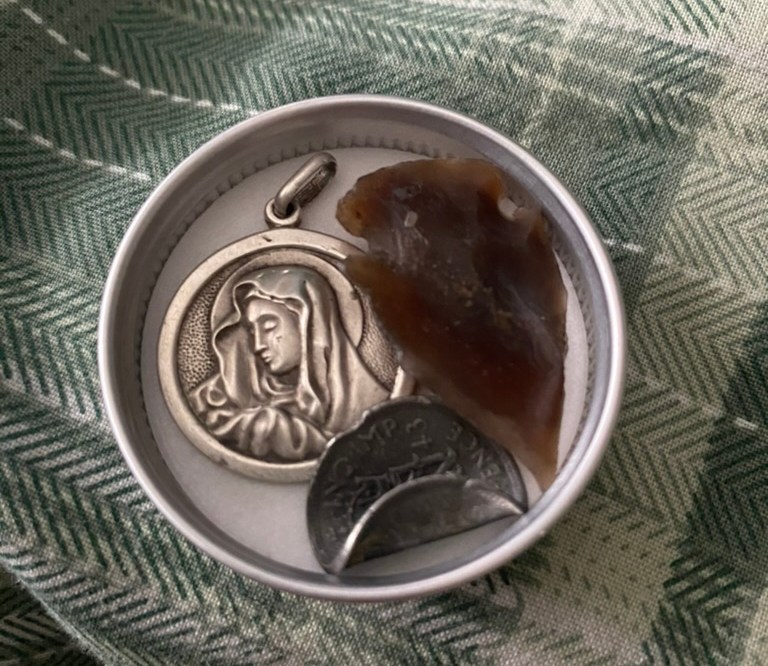
- Elf arrows
- Coins of varying denomination
This itself is not an extensive list by any means, and many of these things will change as required by the practitioner, or as the region they are practicing in will allow for. I use Juniper and Rowan the most as its what I have readily available, you may have Gorse, or a variety of Pine, or something different.
When do you sain?
Saining is typically done on the cross quarter days of the year (Beltaine, Imbolc, Lughnasadh, agus Samhain), but can be done at other times like important events. Sains can be performed when someone gives birth, when someone dies, when someone starts a new job, or when you feel you need to make a big decision without any other influences on you. As saining is a practice that removes the influence of all spirits, it is useful when making life-changing or important decisions, or when you need a sense of clairty to get back on track. This is why one of its definitions is ‘to set things right’. Saining was often a community practice as well. We see people lighting their homes fire from the communal fire made of juniper and rowan on the cross-quarter days. Saining is important as it ensures your prosperity (toradh) isn’t at risk from evil eye (an dròch-shùil), or witchcraft.
Conclusion
So, I hope this article was helpful in some way. I am not teaching you how to sain, as I think that is a journey for you, reader, to start yourself. Saining is an important practice within Scottish folk magic, and should be held sacred and not bastardised by social media, those trying to capitalise from it, and those exploiting it. Scottish folk magic as an activist practice is anti exploitation, and pro-community.


Thank you so much! It means a lot to me that folk are out here reading my stuff and enjoying it ❤️
LikeLike
Brightest Blessings /|
So thoroughly enjoyed!!! I look forward in fervor for more posts by yourself!!!
LikeLike